Yasuke: An African Warrior in 16th-Century Japan

Black history has never existed in only one part of the world.
In 1581, residents of Kyoto encountered someone who attracted extraordinary attention: an African man traveling in Japan.
History remembers him as Yasuke.
We do not know exactly where in Africa he was born. We do not know his birth name with certainty. Much of his life before Japan remains unknown, and after a dramatic series of events in 1582, he largely disappears from the surviving historical record.
What we do know is remarkable enough.
Yasuke traveled in the entourage of Jesuit missionary Alessandro Valignano and eventually encountered Oda Nobunaga, one of the most powerful military leaders of Japan's Sengoku period. Nobunaga took an interest in Yasuke and brought him into his service. Contemporary records describe Yasuke's imposing height and strength, and one diary records him traveling with Nobunaga in 1582.
Within roughly a year of entering Nobunaga's service, Yasuke would also become caught in one of the most famous political upheavals in Japanese history: the Honnō-ji Incident of 1582, which ended with Nobunaga's death.
Then the historical trail goes quiet.
Centuries later, that silence has helped transform Yasuke into something larger than the surviving documents themselves: a subject of books, films, games, anime, historical debate, and legend.
But we don't need the legends to make his story extraordinary.
More than four centuries ago, an African man crossed oceans, entered 16th-century Japanese society, and left enough of a mark that his name survived.
His story is a reminder that the connections between Africa, Asia, Europe, and the wider world are much older than many of us are taught to imagine.
An African Man Arrives in Japan
To understand why Yasuke's presence in Japan was possible, we have to zoom out beyond Japan itself.
The world of the 16th century was already remarkably interconnected.
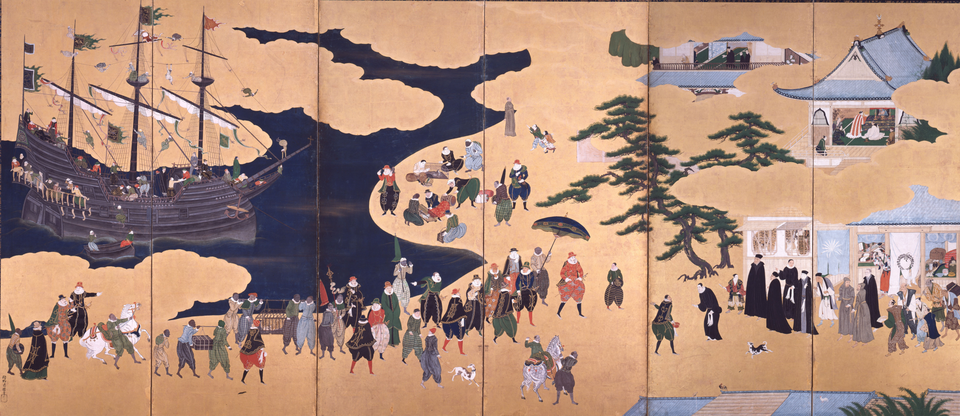
Portuguese ships had established maritime routes connecting Europe with ports throughout Africa and Asia. Merchants, missionaries, sailors, interpreters, soldiers, enslaved people, and free Africans moved through these expanding networks. By the time Yasuke appeared in Japan, Europeans had been sailing regularly through parts of the Indian Ocean and East Asia for decades.
Christian missionaries had reached Japan in 1549, during the country's Sengoku period, an era when competing military lords fought for territory and political power. The Jesuits became involved not only in missionary work but also in the broader networks of diplomacy and international exchange connecting Japan with Portuguese-controlled trade routes.
Into this world stepped Alessandro Valignano, an Italian Jesuit responsible for overseeing the order's missions across parts of Asia.
Yasuke traveled with Valignano's entourage. The precise circumstances of how the two became associated remain uncertain. Some historians have proposed that Yasuke served as a bodyguard, while details about whether he had previously been enslaved, where exactly he was born, and how he traveled from Africa into the Indian Ocean world remain subjects of historical debate.
What is much clearer is that Yasuke arrived in Japan with Valignano in 1579.
That fact alone expands the way we might imagine Black history.
An African man was traveling through Asia decades before the English colony at Jamestown was established in North America and long before the United States existed.
And Yasuke was apparently not the only African person present in 16th-century Japan. Historian Natalia Doan notes that Africans could be found there working in roles including interpretation, military service, and entertainment as Portuguese maritime networks brought people from different parts of the world into contact with Japan.
Yasuke's individual story therefore belongs to something larger: the long history of African people moving through a world that was already global.
Then, in 1581, Yasuke's journey brought him into contact with one of the most consequential figures in Japanese history.
Yasuke Meets Oda Nobunaga
When Yasuke appeared in Kyoto, his presence generated intense curiosity.
Contemporary accounts indicate that crowds gathered to see him. His appearance eventually attracted the attention of Oda Nobunaga, the powerful warlord then pursuing the political and military consolidation of Japan.
According to surviving accounts, Nobunaga initially found Yasuke's dark skin so unfamiliar that he ordered attendants to verify that the color was natural rather than ink or paint. It was.
But Nobunaga's interest apparently went beyond Yasuke's appearance.
A later account based on Nobunaga's circle describes Yasuke as roughly 26 or 27 years old, physically powerful, and possessing extraordinary strength. Surviving evidence indicates that Yasuke soon entered Nobunaga's service.
Think about what that encounter represents.
An African man whose journey had carried him across enormous geographic and cultural distances was now standing in the court of one of Japan's most powerful military leaders.
Two lives originating on opposite sides of the world had intersected in Kyoto.
Yasuke's story did not begin when he reached Japan. His presence there was evidence that Africa was already connected to a much larger world.
In the Service of Oda Nobunaga
After their first encounter in 1581, Yasuke's position in Japan changed dramatically. Rather than remaining solely with Alessandro Valignano's Jesuit entourage, Yasuke entered the service of Oda Nobunaga. Contemporary and near-contemporary records indicate that Nobunaga provided for him and incorporated him into his household. Accounts describe Yasuke receiving a stipend, being given a residence and carrying weapons while serving Nobunaga. This matters because Yasuke was no longer simply a foreign visitor passing through Japan.
He had entered the world of one of the country's most powerful military leaders. Sources also place Yasuke traveling alongside Nobunaga. Historian Thomas Lockley has interpreted the surviving evidence as showing that Yasuke became a close attendant and warrior in Nobunaga's service, possibly serving functions similar to a bodyguard or weapons bearer. And that brings us to the question that follows Yasuke almost everywhere today:
Was Yasuke a Samurai?
The answer depends partly on what we mean by the word. Many modern historians, museums, and reputable publications describe Yasuke as a samurai or as having attained samurai status. The Smithsonian's National Museum of Asian Art, for example, hosted scholarship describing Yasuke as an African warrior who became a close confidant of Nobunaga and was granted samurai status. But the surviving 16th-century documentation of Yasuke is limited, and the social category we now call “samurai” was not necessarily governed by the rigid checklist that modern audiences sometimes imagine. Japan's warrior class and its terminology evolved considerably over time.
Historian Thomas Lockley has argued that serving a lord as an armed retainer in Yasuke's period fits the contemporary meaning of samurai. At the same time, the historical record does not give us a surviving document that neatly says, in modern terms, “Yasuke was officially appointed a samurai on this date.” That is why this article uses the more conservative description:
Yasuke was an African warrior and armed retainer in the service of Oda Nobunaga. That statement doesn't require us to stretch the evidence. And frankly, his documented story is remarkable without doing so. An African man arrived in Japan in 1579. Within two years, he had attracted the attention of one of Japan's most powerful warlords and entered his service. He traveled with Nobunaga, carried weapons, received compensation and lived within his household. Whether a modern reader chooses to call that man a samurai should not overshadow the history we actually possess.
Yasuke does not need a modern legend to make his presence in 16th-century Japan extraordinary.
What the uncertainty teaches us
There's something else worth recognizing here.
When the historical record surrounding a Black figure is thin, there's a temptation to fill the empty spaces with the story we want to exist.
But preserving Black history also means respecting what we don't know. We don't need to invent a kingdom for Yasuke in Africa. We don't need to invent elaborate battles. We don't need to give him a documented title that no surviving document explicitly records. His presence itself expands our understanding of the past.
A Black African man was there. In 16th-century Japan. In the household of Oda Nobunaga. Participating in events that became part of Japanese history. That's history worth remembering.

The Honnō-ji Incident
Yasuke's time in Oda Nobunaga's service would be brief.
In June 1582, only about a year after Yasuke entered Nobunaga's household, one of Nobunaga's own generals, Akechi Mitsuhide, turned against him.
Nobunaga was staying at Honnō-ji temple in Kyoto with a relatively small entourage when Akechi's forces surrounded and attacked the compound. Facing overwhelming forces and with escape effectively impossible, Nobunaga died during the attack, traditionally understood to have committed seppuku as the temple burned. The event became known as the Honnō-ji Incident, one of the pivotal moments of Japan's Sengoku period.
Yasuke was there. Surviving accounts indicate that he fought during the crisis and escaped Honnō-ji. He then made his way to Nijō, where Nobunaga's son Oda Nobutada was attempting to resist Akechi's forces. Yasuke fought again.
Eventually, Nobutada's position was overwhelmed as well. Yasuke surrendered his sword and was taken before Akechi's forces.
What happened next is one of the most discussed moments in Yasuke's story.
A surviving Jesuit account reports that Akechi declined to execute Yasuke and ordered that he be returned to the missionaries. The language attributed to Akechi in that account reflects the racial and cultural prejudices through which Yasuke could be viewed as an African foreigner in 16th-century Japan.
And then— Yasuke disappears from the surviving historical record.
What Happened to Yasuke?
We don't know. That answer isn't as satisfying as the endings later storytellers have imagined, but it is the responsible historical answer. Perhaps Yasuke returned to the Jesuits. Perhaps he remained somewhere in Japan. Perhaps he eventually left the country. Perhaps records describing the remainder of his life once existed and did not survive.
At present, there isn't sufficient evidence to establish what happened to him after the events of 1582. That uncertainty has created enormous room for imagination. Modern novels, manga, anime, films, television projects, and video games have repeatedly reinterpreted Yasuke's life. Each generation has seemingly looked at the relatively small collection of surviving facts and wondered:
What could the rest of his story have been?
There is nothing inherently wrong with historical fiction answering that question.
The problem comes when imagined details quietly become presented as documented history. For Black Joy Global Travel, the distinction matters. We don't need to know every chapter of Yasuke's life to understand the significance of the chapters that survived.
Sometimes the most responsible way to preserve history is to admit where the historical record ends.
Black History Was Already Global
Yasuke's story challenges something much larger than our understanding of one man. It challenges the geography many of us were taught to associate with Black history. Black history is often taught within familiar boundaries:
Africa. The Atlantic slave trade. The Caribbean. The United States. Perhaps Europe. Japan rarely enters that picture. And yet an African man was walking through Kyoto in 1581.
He encountered Jesuit missionaries and Portuguese maritime networks. He met one of Japan's most powerful military leaders. He entered Nobunaga's service. He carried weapons. He traveled within Japan. And he became caught in one of the defining political upheavals of the era. Yasuke's presence reminds us that the world was connected long before airplanes, passports, social media, or modern tourism made global movement feel ordinary.
Africans were part of those connections.
Black people did not suddenly become global in the modern era. We have been moving through, participating in, and shaping the wider world for centuries.
Travel Is Your Birthright
Yasuke's story is not a conventional travel story. He wasn't a tourist arriving in Japan with an itinerary. His journey took place within the complicated religious, commercial, political, and human networks of the 16th century. But his presence there still carries a powerful message for Black travelers today.
There are more places in the world where our history exists than many of us have been taught to imagine.
Travel can reveal those connections. You can stand in a place thousands of miles from home and discover that people who looked like you, came from places connected to you, or shared pieces of your history were there centuries before you. Japan is one of those places. Yasuke's story does not mean that Black people occupied some enormous documented role in 16th-century Japanese society. Nor should one extraordinary individual be stretched into a history the evidence cannot support.
What his story does prove is meaningful enough: An African man was there.
His journey carried him across cultures and continents into a chapter of Japanese history that continues to fascinate people more than four centuries later. And perhaps that should make us curious.
What other connections haven't we learned about?
What histories are sitting in archives halfway around the world?
What could we discover about ourselves by becoming curious about places we've never considered visiting?
That curiosity is part of why we travel.
Sometimes seeing the world isn't about escaping your history. It's about discovering just how much larger your history actually is.
Travel is Your Birthright.
READY TO DISCOVER MORE OF THE WORLD?
Sources & Further Reading
For Yasuke, I want this source list to be a little different from Baker and Du Bois because the distinction between primary evidence and modern interpretation is especially important here.
Matsudaira Ietada — Ietada Nikki (Ietada's Diary)
One of the surviving contemporary Japanese sources referring to Yasuke. A digitized historical copy is available through the Waseda University Library collection.
Digitized Ietada Nikki via Wikimedia Commons/Waseda University Library
Smithsonian Magazine
Who Was Yasuke, Japan's First Black Samurai?
A useful modern overview that discusses the surviving evidence, Yasuke's arrival with Alessandro Valignano, his encounter with Nobunaga, and the uncertainty surrounding his life after 1582.
Smithsonian National Museum of Asian Art
AfricAsia: Overlooked Histories of ExchangeUseful scholarly context for the historical connections between Africa and Asia and modern scholarship surrounding Yasuke.
TIME
The True Story of Yasuke, the Legendary Black Samurai in JapanA secondary overview discussing Yasuke's service under Nobunaga and historians' interpretations of his position in 16th-century Japanese society.


Comments